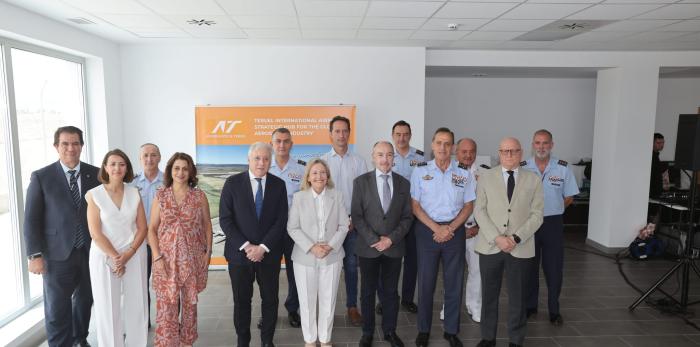
The Ministry of Defense and Teruel Airport are speeding up the implementation of the Comprehensive Training and Air Mobility Center

• The Secretary of State for Defense, María Amparo Valcarce, and the President of the Teruel Airport Consortium, Octavio López, have signed a protocol to expedite all the necessary procedures so that the Air Force and Space Force can operate in Teruel "as soon as possible".
• The concession to the Ministry of the land corresponding to Phase I of the Comprehensive Training and Air Mobility Center (CIEMA) has been approved for 25 years and the documentation has been submitted to process the Declaration of Regional Interest with General Interest (DIGA) relating to Phase II, which includes a natural terrain runway for military transport aircraft.
• The Ministry of Defense plans an investment of nearly 42 million euros for a benchmark infrastructure intended for the training of air transport and deployment support units.
On Tuesday, July 21, 2026, the Ministry of Defense and the Teruel Airport Consortium signed a protocol for the construction of the CIEMA (Comprehensive Air Training and Mobility Center) at Teruel Airport, with a planned investment of €42 million over the coming years.
This investment was announced on August 27, 2025, and is now formalized with the signing of this protocol between the two participating organizations.
During this period, work is underway on the design and project, and the application for a Declaration of Investment of Regional Interest (DIGA), with General Interest to Aragon, has been submitted for the expansion plan of the eastern area of Teruel Airport. The necessary step is approval by the Government Council of Aragon, which will then lead to the development of the Project of General Interest to Aragon (PIGA), whose tendering process is expected soon.
The objective of this protocol is to establish a collaboration between the Ministry of Defense and the Teruel Airport Consortium to facilitate the rapid development of the works and actions aimed at constructing the Comprehensive Training and Mobility Center (CIEMA) on the Consortium's property. The necessary infrastructure, as well as all its connection and operational infrastructure, will be built on this land. This protocol will be valid for four years, with a possible four-year extension to be agreed upon by both parties.
The Ministry of Defense will implement CIEMA. This area will house the necessary facilities to facilitate and improve the instruction and training of Air Transport units and Air Deployment Support units. The project is planned to be carried out in two phases:
- The facilities for the first phase can be located on the grounds of the current Teruel Airport and comprise approximately 6 hectares situated between the access road to the new apron and the airship hangar.
- The facilities for the second phase require a further expansion of Teruel Airport, as there is no available land on the current airport grounds.
Specifically, the proposed CIEMA (Center for Aerospace and Marine Engineering) will include the following facilities:
- A compacted natural terrain runway.
An aircraft parking apron with access to the airport's paved runway.
Operational support and training facilities, with access roads.
Construction of the first phase is scheduled to begin in the second half of 2026, with an estimated 350 jobs to be created once the entire CIEMA infrastructure is completed. This center will provide essential and priority training for pilots and personnel involved in air and transport deployments, short-range unit deployments, drone (UAS) operations, and the establishment of landing zones for crew training.
For the construction of Phase II of CIEMA, it is necessary to expand the current Teruel Airport grounds by approximately 90.27 hectares to the east of the airport's current location, beyond the existing runway. This expansion would be in addition to the 550 hectares currently available.
For his part, the president of the Teruel Airport Consortium emphasized that "Today we are not only signing a collaboration agreement, but also strengthening an alliance between institutions that share a common vision: to put public resources at the service of the general interest, promote the technological and industrial development of our country, and strengthen essential strategic capabilities for Spain, for Aragon, and for the province of Teruel." For López, there is no better endorsement for an aeronautical infrastructure than becoming a benchmark for those who guarantee the security of our country. "The Army and the Ministry of Defense also benefit, because I am convinced that Teruel offers the best possible conditions for their training and development," the Consortium President noted.
The General Manager of Teruel Airport, Alejandro Ibrahim, referred to it as "an excellent development with the incorporation of Defense for the largest aeronautical industrial airport in Europe, in Teruel, which is experiencing another decisive boost with CIEMA."
The application for the DIGA (Declaration of General Interest of Aragon) for this project specifies the technical details of the airport expansion, including the expropriations of the hectares necessary for the construction of Phase II towards the east, as well as all the required civil works.
PROGRESS IN BOTH PHASES OF THE PROJECT
The signing of the protocol coincides with further administrative progress driven by the Airport Consortium. The Governing Council recently approved the concession of the land corresponding to Phase I of CIEMA to the Ministry of Defense for a period of 25 years and an annual fee of €220,577.90, which will allow the implementation of the center's first facilities to begin. This area comprises eight hectares located between the hangar and the stratospheric airship production facility currently under construction and the new aircraft parking apron. There, the Air Force and Space Force will have an office building and a platform for parking military aircraft connected to the airport runway. The project is expected to begin and be completed in 2027.
Furthermore, the Teruel Airport Governing Council has submitted the documentation to the Regional Government's Department of Economy to process the Declaration of Regional Interest with General Interest (DIGA), a necessary step before submitting the PIGA (Integrated Plan for the Development of the Teruel Airport) which will address Phase II of the project.
It is worth noting that the document stipulates that the center will include, among other facilities, a natural terrain runway, aircraft parking aprons connected to the airport's paved runway, hangars, areas for deployable infrastructure, facilities for operational preparation and training, as well as the necessary road access and supply networks.
The Ministry of Defense will promote collaboration among the various administrations involved to expedite the project's development, while the Teruel Airport Consortium will collaborate in preparing the territorial planning instruments and will expedite the reports, licenses, and authorizations required for its execution.
The protocol also provides for the creation of a Monitoring Committee, composed of representatives from both parties, which will coordinate actions and hold its first meeting within a maximum of one month from the signing.
CONSOLIDATION AS A STRATEGIC ENCLAVE
The implementation of CIEMA will consolidate Teruel Airport as a strategic enclave for advanced military air mobility training and reinforce the infrastructure's role as a national and international benchmark in specialized aeronautical activities.
The project will also provide a significant boost to the economic and industrial development of Teruel and Aragon, attracting new investments, generating business activity, and creating skilled jobs linked to the aeronautical and defense sectors.
With this agreement, Teruel Airport continues to expand its capabilities and diversify its activity, incorporating a new area of specialization that complements its current lines of business. At the same time, the Ministry of Defense is making progress in modernizing the necessary infrastructure to improve the readiness of the Armed Forces and strengthen a capability essential for national security and cooperation with allies.
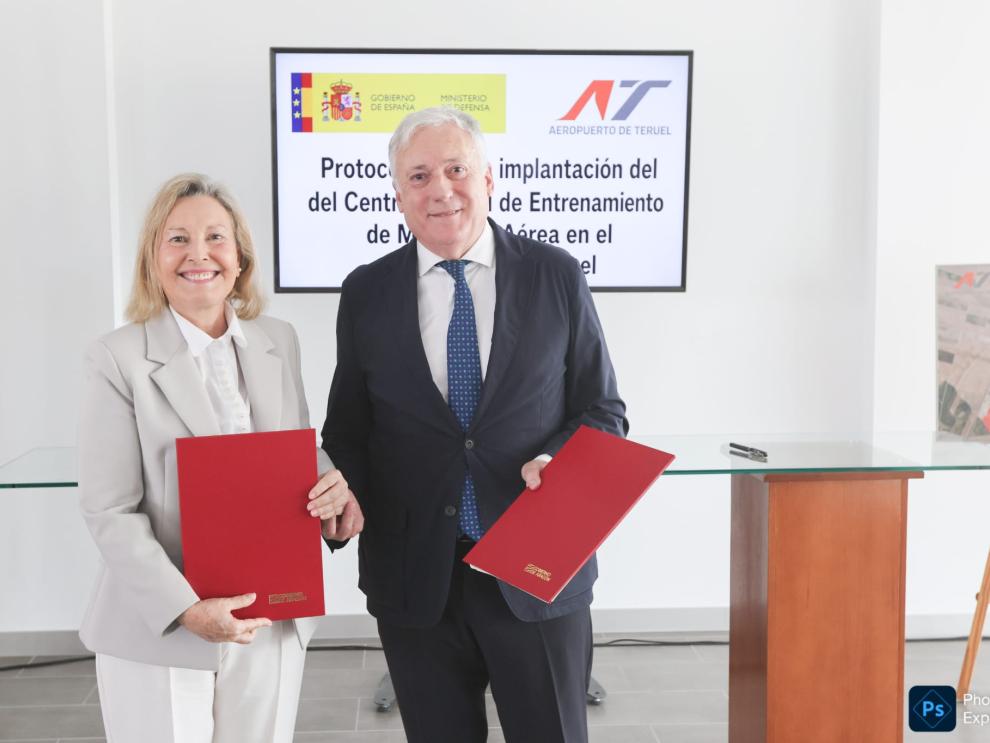
The Secretary of State for Defense, María Amparo Valcarce, and the President of the Teruel Airport Consortium, Octavio López
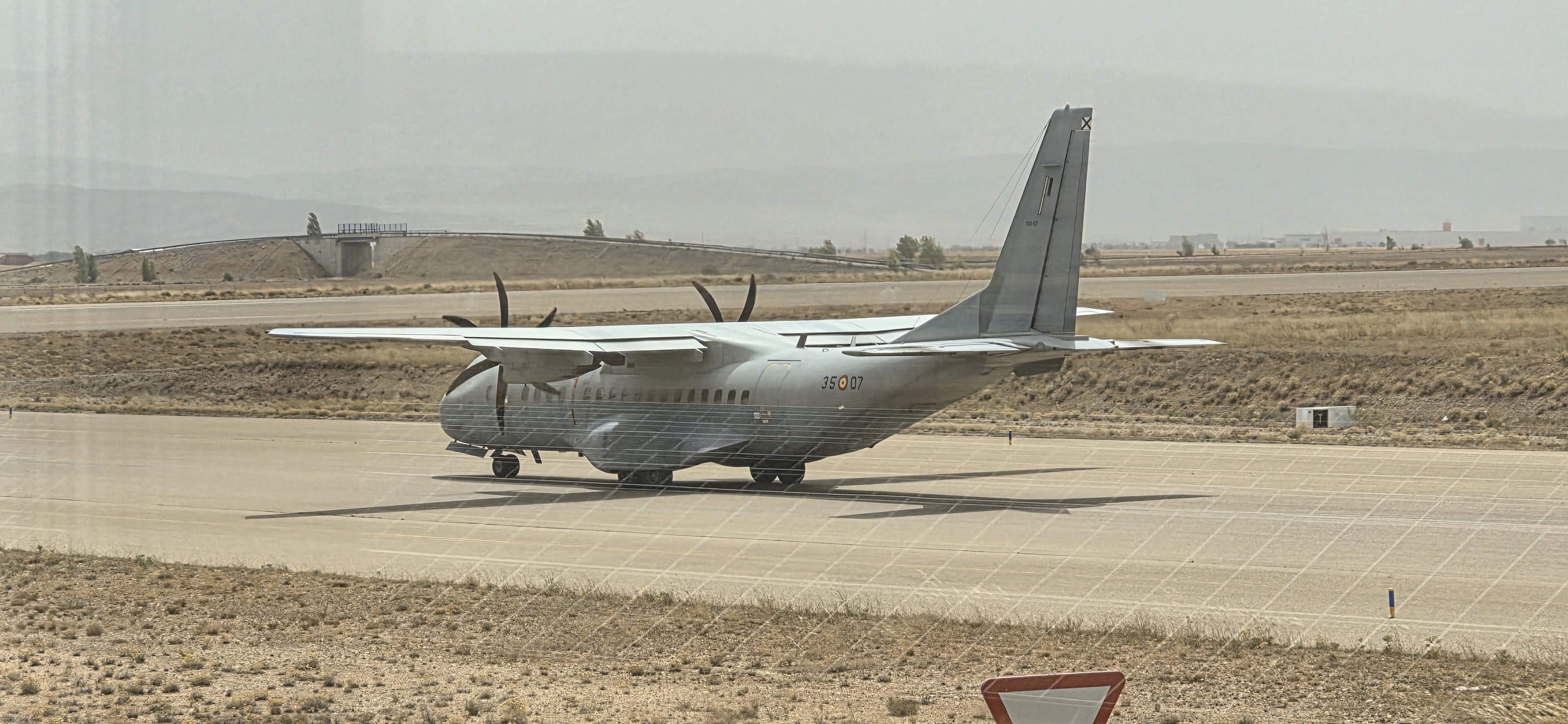
Departure aircraft